


As a supplier of Ratchet Wheel, I often encounter questions regarding the various mechanical properties of our products. One of the most frequently asked questions is about the modulus of elasticity of a ratchet wheel. Understanding this concept is crucial for both engineers and end - users, as it directly impacts the performance and durability of the ratchet wheel in various applications.
Basics of the Modulus of Elasticity
The modulus of elasticity, also known as Young's modulus (denoted by the symbol (E)), is a fundamental property of materials. It measures the stiffness of a material and is defined as the ratio of stress ((\sigma)) to strain ((\epsilon)) within the elastic limit of a material. Mathematically, it can be expressed as (E=\frac{\sigma}{\epsilon}), where stress (\sigma=\frac{F}{A}) (force (F) applied per unit cross - sectional area (A)) and strain (\epsilon=\frac{\Delta L}{L_0}) (change in length (\Delta L) divided by the original length (L_0)).
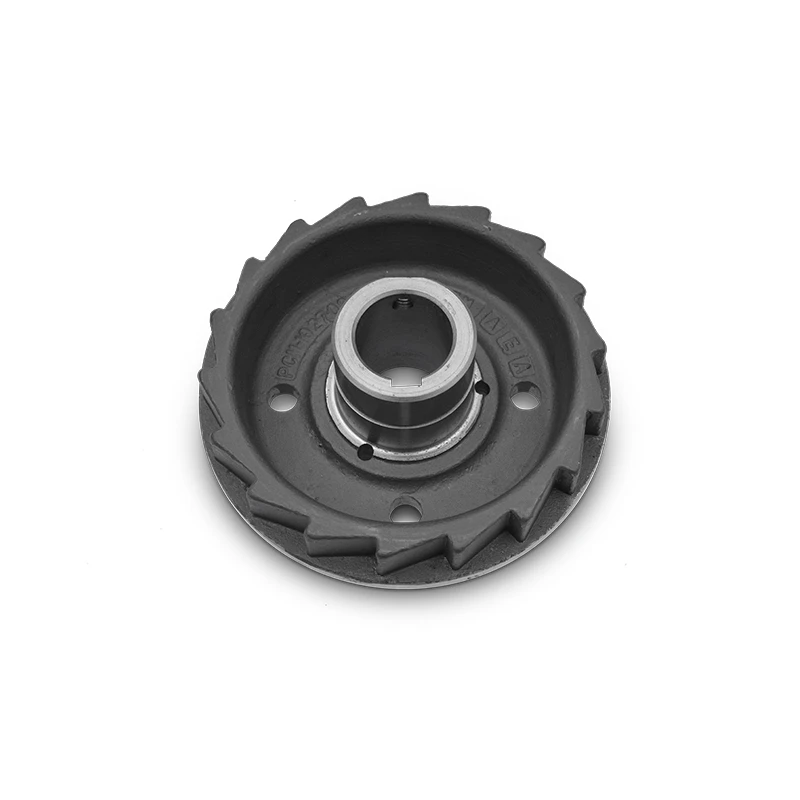
In simpler terms, if a material has a high modulus of elasticity, it means that it requires a large amount of force to produce a small amount of deformation. Conversely, a material with a low modulus of elasticity will deform more easily under a relatively small force.
Modulus of Elasticity of Ratchet Wheels
The modulus of elasticity of a ratchet wheel is determined by the material from which it is made. Ratchet wheels can be fabricated from a variety of materials, each with its own characteristic modulus of elasticity.
Steel
Steel is one of the most common materials used for manufacturing ratchet wheels. It is known for its high strength, durability, and good machinability. The modulus of elasticity of steel typically ranges from (190 - 210) GPa ((190\times10^{9}-210\times10^{9}) Pa). This high modulus value indicates that steel ratchet wheels are very stiff and can withstand significant loads without undergoing excessive deformation. For example, in heavy - duty industrial applications where the ratchet wheel is subjected to large forces, such as in the transmission systems of large machinery, steel ratchet wheels are preferred due to their excellent stiffness.
Aluminum
Aluminum is another material used for ratchet wheels, especially in applications where weight is a critical factor. The modulus of elasticity of aluminum is approximately (70) GPa. Though lower than that of steel, aluminum offers the advantage of being much lighter. This makes aluminum ratchet wheels suitable for applications in the aerospace and automotive industries, where reducing weight can lead to improved fuel efficiency and performance.
Plastic
Plastic ratchet wheels are used in applications that do not require high load - bearing capacity but benefit from features such as corrosion resistance, low cost, and quiet operation. The modulus of elasticity of plastics can vary widely depending on the type of plastic. For example, polycarbonate has a modulus of elasticity in the range of (2 - 3) GPa, while nylon has a modulus of about (1 - 3) GPa. These relatively low values indicate that plastic ratchet wheels deform more easily compared to metal ones, but they can still be suitable for light - duty applications such as in small household tools or consumer products.
Importance of the Modulus of Elasticity in Ratchet Wheel Applications
The modulus of elasticity plays a vital role in determining the performance of a ratchet wheel in its intended application.
Precision and Accuracy
In applications where precise movement and positioning are required, such as in measuring instruments or robotic systems, a ratchet wheel with an appropriate modulus of elasticity is essential. A high - modulus ratchet wheel will deform less under load, ensuring that the movement is consistent and accurate. For instance, in a micrometer, the ratchet wheel mechanism is used to apply a consistent and controlled amount of pressure. A steel ratchet wheel with a high modulus will provide the necessary stiffness to ensure accurate measurements.
Durability and Fatigue Resistance
The modulus of elasticity also affects the durability and fatigue resistance of a ratchet wheel. When a ratchet wheel is subjected to repeated loading and unloading cycles, a material with a suitable modulus can withstand these cyclic stresses without developing cracks or undergoing plastic deformation. For example, in a power - tool ratchet mechanism, the ratchet wheel experiences thousands of cycles during its lifespan. A steel or high - strength plastic ratchet wheel with an appropriate modulus can resist fatigue failure and last for a long time.
Compatibility with Other Components
The modulus of elasticity of a ratchet wheel must be compatible with the other components in the system. For example, if a ratchet wheel is connected to a shaft or a gear, the difference in their moduli can affect the distribution of stresses and the overall performance of the system. If the moduli are too different, there may be uneven loading, leading to premature wear and failure of the components.
Factors Affecting the Modulus of Elasticity of Ratchet Wheels
In addition to the base material, several factors can affect the modulus of elasticity of a ratchet wheel.
Heat Treatment
Heat treatment processes such as annealing, quenching, and tempering can significantly alter the microstructure of the material and, consequently, its modulus of elasticity. For example, quenching and tempering can increase the strength and hardness of steel, which may also result in a slight increase in its modulus of elasticity.
Manufacturing Processes
The manufacturing processes used to produce the ratchet wheel, such as casting, forging, or machining, can also have an impact on its modulus of elasticity. Forging, which involves shaping the material under high pressure, can result in a more uniform grain structure and potentially improve the modulus of elasticity compared to casting, which may introduce porosity and other defects.
Alloying Elements
When alloying elements are added to the base material, they can modify the mechanical properties, including the modulus of elasticity. For example, adding elements like chromium, nickel, and molybdenum to steel can increase its strength and stiffness, thereby affecting its modulus of elasticity.
Selecting the Right Ratchet Wheel Based on Modulus of Elasticity
As a supplier of Ratchet Wheel, we understand that choosing the right ratchet wheel involves a comprehensive consideration of many factors, with the modulus of elasticity being a key one.
First, identify the specific requirements of your application. If it is a heavy - load, high - precision application, a steel ratchet wheel with a high modulus of elasticity is likely the best choice. On the other hand, if weight reduction and corrosion resistance are important, an aluminum or plastic ratchet wheel may be more suitable.
Second, consult with our technical experts. Our team has extensive knowledge and experience in the field of ratchet wheels. We can help you analyze your application requirements and recommend the most appropriate ratchet wheel based on its modulus of elasticity and other relevant properties.
Finally, consider the cost - effectiveness. While high - performance materials may offer better modulus of elasticity and other mechanical properties, they often come at a higher cost. We can work with you to find a balance between performance and cost, ensuring that you get the best value for your investment.
Conclusion
In conclusion, the modulus of elasticity is a crucial property for ratchet wheels. It determines the stiffness, performance, and durability of the ratchet wheel in various applications. As a reliable supplier of Ratchet Wheel, we are committed to providing high - quality products with the appropriate modulus of elasticity to meet the diverse needs of our customers.
If you are in the market for ratchet wheels and would like to discuss your specific requirements, we invite you to reach out to us. Our dedicated sales team is ready to assist you in finding the perfect ratchet wheel solution for your application. We look forward to the opportunity to work with you and contribute to the success of your projects.
References
- Callister, W. D., & Rethwisch, D. G. (2017). Materials Science and Engineering: An Introduction. John Wiley & Sons.
- Ashby, M. F., & Jones, D. R. H. (2005). Engineering Materials 1: An Introduction to Properties, Applications and Design. Butterworth - Heinemann.
- Dieter, G. E. (1988). Mechanical Metallurgy. McGraw - Hill.


